
Biblical Interpretation

How do we decide or interpret what the bible is saying?
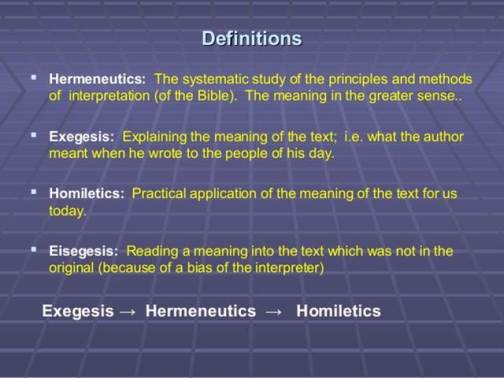
Biblical hermeneutics is the study of the principles and methods of interpreting the text of the Bible.
Cafeteria or salad bar Christians pick and choose what to believe and how to interpret scripture.

Serious bible students use a consistent hermeneutical method of determining what scripture means.
We need to establish a consistent set of rules and principles which we apply to the biblical text similar to a math problem.

The Grammatical-Historical Method
Interpret Grammatically, Historically, and Critically
Interpreting Grammatically
The historical-critical method assumes that words and expressions have a relatively stable meaning during given periods of history. Therefore, we begin by taking what we can determine as the normal, everyday meaning of the words, phrases, and sentences to the extent possible. In other words, our interpretation must correspond to the words and grammar in the text in a reasonable way. Otherwise, the interpreter could assign meaning of his own without objective control. The Bible would become a horoscope of vague sayings we try to plug into our lives however we are able.
The Golden Rule of Biblical Interpretation
“When the plain sense of Scripture makes common sense, seek no other sense; therefore, take every word at its primary, ordinary, usual, literal meaning unless the facts of the immediate context, studied in the light of related passages and axiomatic and fundamental truths, indicate clearly otherwise.”– Dr. David L. Cooper, founder of The Biblical Research Society
This has often been shortened to “When the plain sense of Scripture makes common sense, seek no other sense, lest it result in nonsense.”
Most of the Bible can be easily interpreted by simply taking the language (either in the original or translation) in the usual way (Jn. 3:36; Acts 1:11). In other words, if the plain sense makes sense, seek no other sense.
John 3:36 (NKJV) He who believes in the Son has everlasting life; and he who does not believe the Son shall not see life, but the wrath of God abides on him.”
Acts 1:11 (NKJV) who also said, “Men of Galilee, why do you stand gazing up into heaven? This same Jesus, who was taken up from you into heaven, will so come in like manner as you saw Him go into heaven.”
Use Bible dictionaries or other sources to discover customs, money, geography, etc. Then find a corresponding meaning in our culture.
Good Samaritan (Lk. 10); 2 Denarii (Mk. 6:37); 50,000 Drachma (Acts 19:19)
Pharisees’ teaching on the relationship between illness and sin (Mark  2; John 9:1)
2; John 9:1)
If a passage contains symbols or a special literary genre this should be indicated in the text, either by textual cues, or because symbolism is required in order to make sense of the text.
Most symbols are explained by the Bible itself (Rev. 1:9-20)
Revelation 1:9-20 (NKJV)
I, John, both your brother and companion in the tribulation and kingdom and patience of Jesus Christ, was on the island that is called Patmos for the word of God…….…And having turned I saw seven golden lampstands, 13 and in the midst of the seven lampstands One like the Son of Man, clothed with a garment down to the feet and girded about the chest with a golden band. 14 His head and hair were white like wool, as white as snow, and His eyes like a flame of fire; 15 His feet were like fine brass, as if refined in a furnace, and His voice as the sound of many waters; 16 He had in His right hand seven stars, out of His mouth went a sharp two-edged sword, and His countenance was like the sun shining in its strength. ……………..20 The mystery of the seven stars which you saw in My right hand, and the seven golden lampstands: The seven stars are the angels of the seven churches, and the seven lampstands which you saw are the seven churches.
Interpreting Historically
Historical interpretation means that we take into account the historical background of the author and the recipients as possible. The Bible was written to common people, and is understandable to anyone. However, it was written thousands of years ago to a different culture. Therefore, as modern readers, we have to try to recover a general sense of the meaning of words, phrases and concepts in the ancient cultures. These phrases are addressed in Scripture primarily to the Hebrew and Greco-Roman culture of the first century.
We are not interested at first in the question, “What does it mean to me?” but rather, “what did it mean to those whom it was originally written?“
Rev. 2:12,13 – Pergamum was very wealthy, the center of emperor worship with many temples devoted to idolatry. This was the place ‘where Satan’s throne is’. The phrase has been applied to the complex of pagan cults, of Zeus, Athena, Dionysus and Asclepius.
I Cor. 11:4-6 – Shorn hair was typical of Aphrodite priestess-prostitutes; shaven heads were typical of convicted adulteresses (vs. 5).
Interpret Critically
Your interpretation must make rational sense. If interpretation is permitted to contradict, there in no reason for hermeneutics since we may make a passage say whatever we want.
Six Practical Rules
These rules will enable you to arrive at a critically sound interpretation. Some of these rules are the outgrowth of a high view of scripture. In other words, the entire Bible is the product of one author (God) at the same time that it is product of many authors. Therefore, it is not unreasonable to seek to find a consistent message throughout the Bible.
1.Interpret in light of the context of the passage.
Follow the thought development in the book you are reading, and make sure your interpretation flows along with the general direction of argument. Sudden changes in subject are unusual. If you have the thought development of a book centering on one subject, suddenly switching to another, and then back to the first, your interpretation is almost certainly wrong.
Consider the larger context as well: which Testament? which author? what time period? Never view a passage in isolation from its surroundings. The context should be considered the most important kind of evidence in the interpretation of a passage. Usually context supplies all we need to know. We should turn to other explanations only when we can find no critically feasible interpretation based on the English text in context. Anyone who claims to see a break in context bears the full burden of proof.
Mt. 16:28 – Referring to the transfiguration (in context of passage)
Matthew 16:28 (NKJV)
28 Assuredly, I say to you, there are some standing here who shall not taste death till they see the Son of Man coming in His kingdom.”
28 Assuredly, I say to you, there are some standing here who shall not taste death till they see the Son of Man coming in His kingdom.”
I Cor. 14:34 – Means to disrupt (see I Cor. 11:5 – context of book and passage)
1 Corinthians 14:34 (NKJV)
34 Let your women keep silent in the churches, for they are not permitted to speak; but they are to be submissive, as the law also says.
34 Let your women keep silent in the churches, for they are not permitted to speak; but they are to be submissive, as the law also says.
1 Corinthians 11:5 (NKJV)
5 But every woman who prays or prophesies with her head uncovered dishonors her head, for that is one and the same as if her head were shaved.
5 But every woman who prays or prophesies with her head uncovered dishonors her head, for that is one and the same as if her head were shaved.
2. Interpret in light of progressive revelation
Hebrews 1:1-2 (NKJV)1 God, who at various times and in various ways spoke in time past to the fathers by the prophets, 2 has in these last days spoken to us by His Son, whom He has appointed heir of all things, through whom also He made the worlds;
While God’s purpose for man has never changed, His strategy in accomplishing that purpose has changed. He has dealt with man under different “covenants,” or programs. Therefore, it is important to ask “Under which program was this written?.“
Primary application of the passage will be to the people operating under that program, but not necessarily to others. There may be secondary applications for other programs based on principles which have universal application. Note special problems here in connection with the ministry of Christ before the cross.
Polygamy was permitted in the Old Testament, but taught against in the New Testament (I Tim. 3:2)
1 Timothy 3:2 A bishop then must be blameless, the husband of one wife, temperate, sober-minded, of good behavior, hospitable, able to teach;
Theocracy was commanded in Old Testament, but secular government is affirmed in the New Testament. (Rom. 13:1-7; Mt. 22:21; IIChron. 7:14)
Animal sacrifices, dietary laws, Sabbaths, holy days, festivals, priests and liturgy have all been fulfilled in Christ and are thus obsolete (Col. 2:16,17; Heb. 8).
Mal. 3:7-12 – in context of the testament (see Num. 18:21-24; Deut. 14:22-26)
Malachi 3:7-12 (NKJV)7 Yet from the days of your fathers You have gone away from My ordinances And have not kept them. Return to Me, and I will return to you,” Says the LORD of hosts. “But you said, ‘In what way shall we return?’8 “Will a man rob God? Yet you have robbed Me! But you say, ‘In what way have we robbed You?’ In tithes and offerings.9 You are cursed with a curse, For you have robbed Me, Even this whole nation.10 Bring all the tithes into the storehouse, That there may be food in My house, And try Me now in this,” Says the LORD of hosts, “If I will not open for you the windows of heaven And pour out for you such blessing That there will not be room enough to receive it.
11 “And I will rebuke the devourer for your sakes, So that he will not destroy the fruit of your ground, Nor shall the vine fail to bear fruit for you in the field,” Says the LORD of hosts;12 “And all nations will call you blessed, For you will be a delightful land,” Says the LORD of hosts.
11 “And I will rebuke the devourer for your sakes, So that he will not destroy the fruit of your ground, Nor shall the vine fail to bear fruit for you in the field,” Says the LORD of hosts;12 “And all nations will call you blessed, For you will be a delightful land,” Says the LORD of hosts.
Numbers 18:21-24 (NKJV)21 “Behold, I have given the children of Levi all the tithes in Israel as an inheritance in return for the work which they perform, the work of the tabernacle of meeting.22 Hereafter the children of Israel shall not come near the tabernacle of meeting, lest they bear sin and die.23 But the Levites shall perform the work of the tabernacle of meeting, and they shall bear their iniquity; it shall be a statute forever, throughout your generations, that among the children of Israel they shall have no inheritance.24 For the tithes of the children of Israel, which they offer up as a heave offering to the LORD, I have given to the Levites as an inheritance; therefore I have said to them, ‘Among the children of Israel they shall have no inheritance.’ ”
Deuteronomy 14:22-29 (NKJV)
22 “You shall truly tithe all the increase of your grain that the field produces year by year. 23 And you shall eat before the LORD your God, in the place where He chooses to make His name abide, the tithe of your grain and your new wine and your oil, of the firstborn of your herds and your flocks, that you may learn to fear the LORD your God always. 24 But if the journey is too long for you, so that you are not able to carry the tithe, or if the place where the LORD your God chooses to put His name is too far from you, when the LORD your God has blessed you, 25 then you shall exchange it for money, take the money in your hand, and go to the place which the LORD your God chooses. 26 And you shall spend that money for whatever your heart desires: for oxen or sheep, for wine or similar drink, for whatever your heart desires; you shall eat there before the LORD your God, and you shall rejoice, you and your household.
3. Interpret scripture in harmony with other scripture.
Since the Bible is inspired by God, it does not contradict itself. Therefore, never interpret scripture in such a way that it clearly contradicts other scriptures. First discover the allowable range of meaning for a passage, then choose the interpretation that doesn’t contradict other scriptures.
Acts 2:38 could either be referring to baptismal regeneration, or simply adding baptism as a desirable adjunct to the minimum requirement for salvation (i.e. faith).
Jas. 2:14-26 “justify” can also mean “justify before men.“ James was not contradicting Paul. Justification before God is by faith alone, as Paul wrote. James is talking about showing your faith before men as a sign of justification.
4.Interpret the unclear in light of the clear.
Scripture teaches every major, essential truth clearly and many times. Never build a doctrine on an unclear passage.
Lk. 16:9 is used by Roman Catholics to support indulgences.
Luke 16:9 (ESV) And I tell you, make friends for yourselves by means of unrighteous wealth, so that when it fails they may receive you into the eternal dwellings.
I Cor. 15:29 mentions an obscure, unknown practice used in Corinth. Today the Mormon church uses this passage to elevate dead ancestors to a higher status in the afterlife.
1 Corinthians 15:29 (ESV) Otherwise, what do people mean by being baptized on behalf of the dead? If the dead are not raised at all, why are people baptized on their behalf?
5. Interpret the “spirit” of the passage,
not necessarily the “letter”, or the literalistic meaning, especially when the text is a literary genre prone to figures of speech or colorful statements.
Proverbs 22:6 The book of Proverbs contains many general maxims, but not all are absolute promises. Not every child will go right, but most will.
Proverbs 15:1 Not every gentle word will turn away wrath, but in most cases it will.
I Cor. 11:1-18 – In some New Testament passages interpretation by the “letter” contradicts the “spirit” of the passage (c.f. I Cor. 10:32,33).
6. Interpret with dependence upon the Holy Spirit,
allowing Him to teach you. Mark T or F.
Proverbs 3:5 “Lean not unto your own understanding” means we should avoid approaching the Bible on a primarily analytical level.
Since the Bible is “living and active”, the interpretation of a passage may be different for different people.
Unless we approach God’s word with a deep reverence for God and a passion to know His will for our lives, we may often get the wrong interpretation.
If the rules of interpretation give one answer and the Holy Spirit shows another, we should choose the latter.
We should pray before studying that God will enable us to understand the passage.

Exegesis vs Eisegesis
Exegesis and eisegesis are two opposing views to the study of the Bible. Exegesis refers to an explanation of the biblical text based on an investigation of the language, history, culture, and context of a passage in its original setting. Eisegesis refers to interpretation of a passage of Scripture based on a subjective understanding of the text.

Exegesis is the approach to Bible study that does the text justice and seeks true understanding of God’s Word. It looks at what the text says in appropriate context, wanting to learn from the text rather than wanting to use the text to support a preconceived notion. Second Timoth y 2:15 teaches, “Do your best to present yourself to God as one approved, a worker who has no need to be ashamed, rightly handling the word of truth.” Those who follow Christ are called to study His Word with diligence and to handle it rightly. Exegesis is a method of study that promotes this.
y 2:15 teaches, “Do your best to present yourself to God as one approved, a worker who has no need to be ashamed, rightly handling the word of truth.” Those who follow Christ are called to study His Word with diligence and to handle it rightly. Exegesis is a method of study that promotes this.
Eisegesis is often associated with postmodern culture and literary study. While every person brings some level of personal bias to his or her understanding of the Bible, eisegesis focuses on using this bias as the basis for interpretation.
 Instead of asking, “What does this biblical passage mean?” eisegesis asks, “What does this verse mean to me?” or “How does this passage make me feel?“
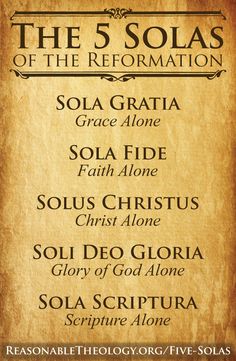
Sola scriptura emphasizes the Bible alone as the source of authority for Christians. By saying, “Scripture alone,” the Reformers rejected both the divine authority of the Roman Catholic Pope and confidence in sacred tradition. Only the Bible was “inspired by God” (2 Peter 1:20-21) and “God-breathed” (2 Timothy 3:16-17). Anything taught by the Pope or in tradition that contradicted the Bible was to be rejected. Sola scriptura also fueled the translation of the Bible into German, French, English, and other languages, and prompted Bible teaching in the common languages of the day, rather than in Latin.
The above post may contain copyrighted material the use of which has not always been specifically authorized by the copyright owner. It is being made available in an effort to advance the understanding of environmental, political, human rights, economic, democracy, scientific, social justice, for the purpose of historical debate, and to advance the understanding of Christian conservative issues. It is believed that this constitutes a ”fair use” of any such copyrighted material as provided for in section 107 of the Copyright Law. In accordance with the title 17 U.S. C. section 107, the material in this post is shown without profit to those who have expressed an interest in receiving the included information for research and educational purposes.
Federal law allows citizens to reproduce, distribute and exhibit portions of copyrighted motion pictures, video taped or video discs, without authorization of the copyright holder. This infringement of copyright is called “Fair Use”, and is allowed for purposes of criticism, news, reporting, teaching, and parody. This articles is written, and any image and video (includes music used in the video) in this article are used, in compliance with this law: Copyright Act of 1976, 17 U.S.C. 107.
Worthynews.com/ Christian news service


