Showing posts with label Galatians. Show all posts

Monday, May 20, 2019

Galatians Chapter 4


Sons and Heirs
gal41
1 I mean that the heir, as long as he is a child, is no different from a slave, though he is the owner of everything, 2 but he is under guardians and managers until the date set by his father. 3 In the same way we also, when we were children, were enslaved to the elementary principles of the world. 4 But when the fullness of time had come, God sent forth his Son, born of woman, born under the law, 5  to redeem those who were under the law, so that we might receive adoption as sons. 6 And because you are sons, God has sent the Spirit of his Son into our hearts, crying, “Abba! Father!” 7 So you are no longer a slave, but a son, and if a son, then an heir through God.
.
1. Is Paul now changing the subject?
No. Paul is continuing to drive home his point that the law was a temporary situation and had served its purpose.In the previous chapter he had shown them that believers in the gospel were the true children of Abraham; that they had been delivered from the curse of the law; that the law was a schoolmaster to lead them to Christ, and that they were all the children of God. BN

Whereas in chapter 3 Paul dealt mainly with justification (my position on Christ), in chapter 4 his emphasis was primarily on sanctification (How are we now to live the Christian life). CN

So then, the law was our guardian until Christ came, in order that we might be justified by faith Gal 3:24 (ESV)
.
2. The slave analogy illustrates what principle?
 The slave as well as the child has restricted freedom. In respect to ability to make decisions both groups are identical in that they both are under the authority of their managers.
gal42
Again we will have to go back to the Roman customs to see Paul’s illustration in action. In a Roman home servants had charge of different possessions of the master. Some had charge of the chattels, others of the livestock, others kept books for him, and others had charge of his children. When a little one was born into the home, the servants cared for him and dressed him in play clothes so that he didn’t look any different from the children of the servants with whom he was playing. And he had to obey the servants just like the other children did. JVM
.
3. What does Paul point to as the major factor in bringing us out of slavery to the law?
Redemption and the indwelling Holy Spirit.  The blood of Christ paid the price to buy us back out of bondage to the law.  The Holy Spirit in us guarantees out position.

You were bought with a price; do not become slaves of men. 1 Cor 7:23 (ESV)

gal43
And I will ask the Father, and he will give you another Helper, to be with you forever, 17 even the Spirit of truth, whom the world cannot receive, because it neither sees him nor knows him. You know him, for he dwells with you and will be in you. John 14:16-17 (ESV)

 When you believed, you were marked in him with a seal, the promised Holy Spirit, 14 who is a deposit guaranteeing our inheritance until the redemption of those who are God’s possession—to the praise of his glory. Eph. 1:13-14
.
Paul’s Concern for the Galatians
gal44
8 Formerly, when you did not know God, you were enslaved to those that by nature are not gods. 9 But now that you have come to know God, or rather to be known by God, how can you turn back again to the weak and worthless elementary principles of the world, whose slaves you want to be once more? 10 You observe days and months and seasons and years! 11 I am afraid I may have labored over you in vain. 12 Brothers, I entreat you, become as I am, for I also have become as you are. You did me no wrong. 13 You know it was because of a bodily ailment that I preached the gospel to you at first, 14 and though my condition was a trial to you, you did not scorn or despise me, but received me as an angel of God, as Christ Jesus. 15 What then has become of the blessing you felt? For I testify to you that, if possible, you would have gouged out your eyes and given them to me. 16 Have I then become your enemy by telling you the truth? 17 They make much of you, but for no good purpose. They want to shut you out, that you may make much of them. 18 It is always good to be made much of for a good purpose, and not only when I am present with you, 19  my little children, for whom I am again in the anguish of childbirth until Christ is formed in you! 20 I wish I could be present with you now and change my tone, for I am perplexed about you.
.
4. What is so puzzling to Paul?
gal45
 “how can you turn back?” Why would you want to go back to being enslaved by a worthless system which can never bring life?  What is the motivation for me to want to go back to being treated like a first grader where I have to raise my hand to use the restroom? Is there security for spiritually immature Christians to want to live under a set of written rules such that they don’t have to depend on the Spirit?
“I am perplexed about you.”
.
5. What is all this about days and months?
“Ye observe days,” meaning the sabbath days. Paul said to the Colossians, “Let no man therefore judge you in meat, or in drink, or in respect of an holyday, or of the new moon, or of the sabbath days” (Col. 2:16).
“Months” probably refers to the observance of the “new moon” practiced by the people of Israel in the time of the kings. The prophets warned them against it.
“Times” should be translated seasons, meaning feasts. God had given Israel seven feasts, but they all had pointed to the Lord Jesus Christ.
“Years” of course would refer to the sabbatic years. The observance of all these things would put these gentile believers completely back under the Mosaic Law.
gal46

Today we hear legalists claim they are keeping the Mosaic Law, yet they are keeping only the sabbath day. All the law comes in one package, including the sabbatic year and the Year of Jubilee. James in his epistle said, “For whosoever shall keep the whole law, and yet offend in one point, he is guilty of all” (James 2:10). That is, he is guilty of being a lawbreaker. JVM

These Galatians were formally gentile pagans who had never lived under the Jewish Ceremonial laws and now they had been convinced by the Judaizers that they needed to observe all these practices which had been given to the Jewish people as metaphors of   Christ.
.
6. What “bodily ailment” is Paul referring to?
Probably Paul’s thorn in the flesh was some sort of eye trouble, and it evidently made him very unattractive. I cannot conceive of them wanting to pluck out their eyes and give them to Paul if what he really needed was another leg. Apparently Paul had an eye disease which is common in that land and is characterized by excessive pus that runs out of the eyes. You can well understand how unattractive that would be to look at while he was ministering to them. Paul says, “You just ignored it, and received me so wonderfully when I preached the gospel to you.” JVM

See with what large letters I have written to you with my own hand! Gal 6:11 (NKJV)
.
Example of Hagar and Sarah
21 Tell me, you who desire to be under the law, do you not listen to the law? 22 For it is written that Abraham had two sons, one by a slave woman and one by a free woman. 23 But the son of the slave was born according to the flesh, while the son of the free woman was born through promise. 24 Now this may be interpreted allegorically: these women are two covenants. One is from Mount Sinai, bearing children for slavery; she is Hagar. 25 Now Hagar is Mount Sinai in Arabia; she corresponds to the present Jerusalem, for she is in slavery with her children. 26 But the Jerusalem above is free, and she is our mother. 27 For it is written, “Rejoice, O barren one who does not bear; break forth and cry aloud, you who are not in labor! For the children of the desolate one will be more than those of the one who has a husband.” 28 Now you, brothers, like Isaac, are children of promise. 29 But just as at that time he who was born according to the flesh persecuted him who was born according to the Spirit, so also it is now. 30 But what does the Scripture say? “Cast out the slave woman and her son, for the son of the slave woman shall not inherit with the son of the free woman.” 31 So, brothers, we are not children of the slave but of the free woman.
.
7. These two sons of Abraham, how did they differ?
Ishmael was the son by the Egyptian slave Hagar. This was not Gods plan. This was the result of a plan cooked up by Sarah and Abraham. Paul allegorically identifies Hagar with My Sinai in Arabia in the respect that her children were under slavery to their fleshly natures as the Hebrews were under slavery to theirs and had to be restricted by the Mosaic Law which was given on Mt. Sinai or Mt. Horeb.

He shall be a wild donkey of a man, his hand against everyone and everyone’s hand against him, and he shall dwell over against all his kinsmen.” Gen 16:12 (ESV)

 These are the ancestors of the Arabs which is very telling with respect to the situation on the Middle East today.

Is Sarah your wife shall bear you a son, and you shall call his name Isaac. I will establish my covenant with him as an everlasting covenant for his offspring after him. ……………………….. 21 But I will establish my covenant with Isaac, whom Sarah shall bear to you at this time next year.” Gen 17:19-21 (ESV)

I will be with you and will bless you, for to you and to your offspring I will give all these lands, and I will establish the oath that I swore to Abraham your father. 4  I will multiply your offspring as the stars of heaven and will give to your offspring all these lands. And in your offspring all the nations of the earth shall be blessed, 5 because Abraham obeyed my voice and kept my charge, my commandments, my statutes, and my laws.” Gen 26:3-5 (ESV)
Isaac was a man of faith, gentleness and wisdom.
.
8. What happened to Ishmael?
gal48
He was driven away. The son of the flesh and the son of the promise could not coexist. You cannot mix the flesh and the Spirit and you cannot mix law and grace. Paul is telling the Galatians that they need to choose the promises of God over the curse of the law and they need to drive out the Judaizers.


24 “No one can be a slave of two masters, since either he will hate one and love the other, or be devoted to one and despise the other. Matt 6:24 (HCSB)

  Early in the morning Abraham got up, took bread and a waterskin, ⌊put them⌋ on Hagar’s shoulders, and sent her and the boy away. Gen 21:14 (HCSB)

 17 God heard the voice of the boy, and the angel of God called to Hagar from heaven and said to her, “What’s wrong, Hagar? Don’t be afraid, for God has heard the voice of the boy from the place where he is. 18 Get up, help the boy up, and support him, for I will make him a great nation.” 19 Then God opened her eyes, and she saw a well of water. So she went and filled the waterskin and gave the boy a drink. 20 God was with the boy, and he grew; he settled in the wilderness and became an archer. 21 He settled in the Wilderness of Paran, and his mother got a wife for him from the land of Egypt. Gen 21:17-21 (HCSB)
.
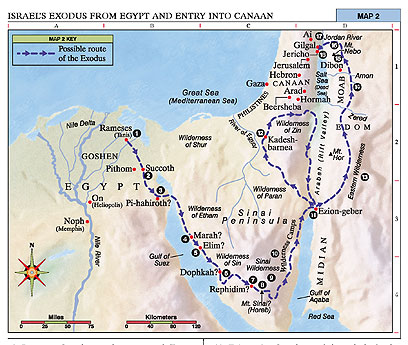
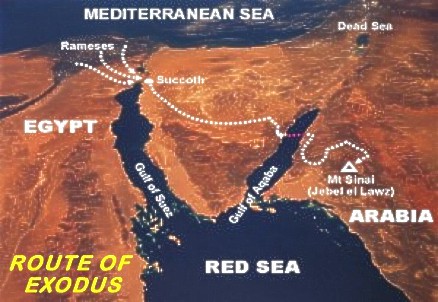
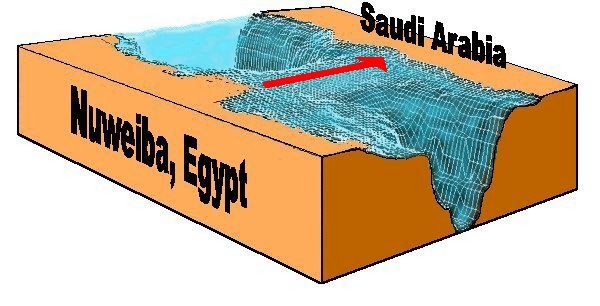
9. Just for fun:  where is Mt. Sinai?
 The scripture says it is in Arabia but most bible maps put it in the Sinai Peninsula.
     
gal49gal412gal410

The blackened peak of Jebel El Lawz and the rock of Horeb where Moses split the rock and water gushed out.

gal414gal417
gal418

Chariot wheels found at the bottom of the Red Sea at the Nuweiba crossing point.
The traditional Mt. Sinai was “discovered” by the mother of the Emperor Constantine based on a “dream” she had. There is no archaeological evidence to establish this as the actual location of the mountain where Moses received the Commandments.  The Roman Catholic built a monastery at the base of the mountain.
  • ESVN………….ESV Study Bible Notes
  • MSBN…….MacArthur NASB Study Notes
  •  BDB………….. Barclay’s Daily Study Bible (NT)
  • NIVSN…..NIV Study Notes.
  • JVM ….J Vernon McGee,
  • ACC …. Adam Clarke’s Commentary
  • BN …..Barnes Notes
  • WBC……   Wycliffe Bible Commentary
  • CN …… Constables Notes
  • IC……….Ironside Commentary
  • NET………Net Bible Study Notes.
  • JFB…………..Jamieson  Fausset  Brown Commentary
  • VWS……………..Vincent Word Studies
  • CMM………….Commentary on Matthew and Mark
  • BDB………….. Barclay’s Daily Study Bible (NT)
  • Darby………..John Darby’s Synopsis of the OT and NT
  • Johnson………Johnson’s Notes on the New Testament.
  • NTCMM…………..The New Testament Commentary:  Matthew and Mark.


“Fair Use “ Notice – Title 17 U.S.C. section 107
The above post may contain copyrighted material the use of which has not always been specifically authorized by the copyright owner. It is being made available in an effort to advance the understanding of environmental, political, human rights, economic, democracy, scientific, social justice, for the purpose of historical debate, and to advance the understanding of Christian conservative issues.  It is believed that this constitutes a ”fair use” of any such copyrighted material as provided for in section 107 of the Copyright Law. In accordance with the title 17 U.S. C. section 107, the material in this post is shown without profit to those who have expressed an interest in receiving the included information for research and educational purposes.

Saturday, March 12, 2016

Galatians Chapter 6


1 Brothers, if anyone is caught in any transgression, you who are spiritual should restore him in a spirit of gentleness. Keep watch on yourself, lest you too be tempted. 2  Bear one another’s burdens, and so fulfill the law of Christ. 3 For if anyone thinks he is something, when he is nothing, he deceives himself. 4 But let each one test his own work, and then his reason to boast will be in himself alone and not in his neighbor. 5 For each will have to bear his own load. 6  One who is taught the word must share all good things with the one who teaches. 7  Do not be deceived: God is not mocked, for whatever one sows, that will he also reap. 8 For the one who sows to his own flesh will from the flesh reap corruption, but the one who sows to the Spirit will from the Spirit reap eternal life. 9 And let us not grow weary of doing good, for in due season we will reap, if we do not give up.10 So then, as we have opportunity, let us do good to everyone, and especially to those who are of the household of faith.
.
1. Caught in any transgression? Is this one of those “gotcha” type of things?
Being free from the Mosaic Law does not mean being free from responsibility. In this section Paul explained various responsibilities that Christians have to one another to clarify the will of God for his readers.
The situation Paul envisioned here is that of sin overtaking a Christian as a runner overtakes a walker. It is not that God has caught him in the act of sinning as much as that sin has gotten the better of him in a particular instance. He has been surprised by sin rather than detected in it. “Trespass” (Gr. paraptoma) is not habitual action but an isolated act. Neither is it intentional sin but inadvertent wrongdoing. CN
.
2. Who should do the restoring here? Is this the job of the clergy or pastors etc.?

This does not refer to an elite class of Christians but rather to those who have more maturity and experience in the Christian life and who are therefore in a position to help their beleaguered brother or sister. The adjective “spiritual” means “living and walking according to the Holy Spirit”. ESV

However the “spiritual” Christian is the one that should do this, namely, one whose life bears the fruit of the Spirit because he or she habitually walks by the Spirit. The more spiritually mature, having walked by the Spirit for some time. The spiritual Christian must restore the Christian who has stumbled gently, carefully, and cautiously. The spiritual Christian can avoid a spirit of self-righteousness in dealing with those who stumble by remembering his or her own personal vulnerability to temptation.

The word used for “restore” in this verse is a verb which means “to set a broken bone.” If a fellow falls down and breaks his leg, what are you going to do? Are you going to walk off and leave him in pain? God says, “You who are spiritual set the broken bone. Get him back on his feet again.” It is to be done in the spirit of meekness .JVM
.
3. How can we bear another’s burdens?
To bear one another’s burdens is the supreme imitation of Jesus, the ultimate burden-bearer. Now burden (baros) means “fault”—“If a man be overtaken in a fault.” That’s his burden. You could help him bear it. It also means infirmity, a weakness, an ignorance, a pressure, a tension, a grief. To bear one another’s burdens is the supreme imitation of Jesus, the ultimate burden-bearer. He has even gone to the length of taking mankind’s sins and the curse of the law upon himself. and so fulfill the law of Christ. Though Paul insists that the Galatians are free from obeying Jewish ceremonial laws, this does not mean they are free from all of God’s moral requirements. The “law of Christ” in a broad sense means the entire body of ethical teaching that Jesus gave and endorsed, but in a specific sense here it probably refers to the command to love one’s neighbor as oneself, which, if followed fully, will result in obeying the rest of God’s moral law.
.
4. What is the danger here?
The danger comes from legalistically dealing with the faults of others. Legalists tend to evaluate their personal spirituality in light of the performance of others. The legalist thus rejoices at the fall of another brother, since he appears better in comparison. His response is that of smug superiority and self-righteous condemnation. His judgment makes him blind to his own sins. The scribes and Pharisees were“shocked” at the sin of the woman caught in adultery, but they were aloof about their sins concerning pride, materialism, and their neglect of the widows and orphans, and even of their own parents.

Paul elsewhere soundly condemned the practice of measuring ourselves against others: “For we are not bold to class or compare ourselves with some of those who commend themselves; but when they measure themselves by themselves, and compare themselves with themselves, they are without understanding” 2 Cor. 10:12 Bob Deffinbaugh bible .org
.
5. Sowing and reaping, is this Karma?
If a person selfishly withholds what he has, he will not see God multiply it and bless him with it. If he follows the prompting of his sinful nature in his investments, he will reap death, but if he follows the Spirit, he will reap life. This is not saying he will necessarily die but that his sowing will yield a disappointing harvest. Neither is it saying that he can earn justification. It is saying that his sowing will yield the best harvest. Our harvest will suffer if we grow weary and stop sowing. Remember that the context of this section is the support of Christian workers, though these principles certainly have wider application.
“Paul here seems to regard the whole of a man’s earthly life as a period of sowing, with harvest awaiting him on the last day: the eschatological yield is determined by present sowing.” The term “eternal life”has two different though related meanings in the New Testament. Essentially it is the life of God that He shares with believers. On the one hand, the New Testament writers spoke of it as a gift that one receives by faith. However it also refers to the quality of the believer’s life that depends on the extent to which he or she walks with God in fellowship. In this second sense, some believers experience eternal life to a greater extent than other believers do. It is in this second sense that Paul spoke of eternal life here. CN

While believers await their rewards they should do good. The primary focus should be on serving those in the church, but never to the exclusion of people in the wider world.
Sowing and reaping: This is an immutable law that operates in every sphere of life. In agriculture and horticulture if you sow corn, you get corn; if you sow cotton, you reap cotton. In the moral sphere you also reap what you sow. God says you will reap what you sow. God will not be mocked. When you sow corn, you reap corn. When you sow sin, that is what you will reap, you will reap the consequences of that sin, either in this life or the next. JVM 

But I say to you that for every idle word men may speak, they will give account of it in the day of judgment.  For by your words you will be justified, and by your words you will be condemned.” Matt 12:36-37 (NKJV)
.
11 See with what large letters I am writing to you with my own hand. 12 It is those who want to make a good showing in the flesh who would force you to be circumcised, and only in order that they may not be persecuted for the cross of Christ. 13 For even those who are circumcised do not themselves keep the law, but they desire to have you circumcised that they may boast in your flesh. 14 But far be it from me to boast except in the cross of our Lord Jesus Christ, by which the world has been crucified to me, and I to the world. 15 For neither circumcision counts for anything, nor uncircumcision, but a new creation. 16 And as for all who walk by this rule, peace and mercy be upon them, and upon the Israel of God. 17 From now on let no one cause me trouble, for I bear on my body the marks of Jesus. 18  The grace of our Lord Jesus Christ be with your spirit, brothers. Amen.
.
6. Why does Paul mention his hand writing?
Paul is saying that he has written with large letters, which is characteristic with folk who have poor vision. This, I believe, bears out the theory that Paul’s“thorn in the flesh” was eye trouble (see 2 Cor. 12:7). As you recall, he had said to them earlier, “… I bear you record, that, if it had been possible, ye would have plucked out your own eyes, and have given them to me” (Gal. 4:15). I am sure that Paul had a serious visual problem.
When Paul wrote his Epistle to the Romans, he dictated it to a secretary. And at the conclusion of the letter, Paul said to the secretary, “Now if you want to put in your greetings, go ahead and do it.” So in Romans 16:22 we have the secretary’s salutation: “I Tertius, who wrote this epistle, salute you in the Lord.”
However, when Paul wrote to the Galatians, he was angry.He had heard that they were mixing the gospel with law—and when that is done, the gospel of the grace of God is absolutely destroyed. He couldn’t wait for a secretary to arrive—he just sat down and wrote to them himself. Because he didn’t see clearly, he wrote with large letters. JVM
.
7. From Paul’s perspective what is the compelling motivation for the Judaizers to insist on circumcise?
The issue which Paul makes with the Judaizers is that between the cross of Christ and circumcision. To Paul, the cross was the source of his salvation. More than anything else, the “cross” summarized Paul’s message, while circumcision was the essence of the teaching of the Judaizers. The real reason for this is explained in verses 12-17. Paul gloried (boasted) in the cross of Christ, for it was there that his sins were washed away, borne by the Savior. The gospel which he preached was the message of the cross .
To the Judaizers the cross was offensive because it was the cause of their persecution and suffering. To find one’s salvation solely in the cross of Christ was so abominable to the unbelieving Jew that those who thus believed were persecuted. To avoid this persecution, the Judaizers played down the cross and promoted circumcision. This setting aside of the cross for circumcision enabled the Judaizers to gain the praise of the Jews, rather than the persecution which Paul and other Christians experienced. To Paul, the cross was everything and neither circumcision nor uncircumcision was anything. Bob Deffinbaugh bible.org
.
8. What marks of Jesus did Paul bear on his body?
Notice the word marks. Paul is saying, “I bear in my body the ‘marks’”—the Greek word is stigmata—meaning ‘scar marks.’ If you want to see the handwriting of Jesus, look upon Paul’s body. In 2 Corinthians 11:23–27 he tells us, “Are they ministers of Christ? (I speak as a fool) I am more; in labours more abundant, in stripes above measure, in prisons more frequent, in deaths oft. Of the Jews five times received I forty stripes save one. Thrice was I beaten with rods, once was I stoned, thrice I suffered shipwreck, a night and a day I have been in the deep; In journeyings often, in perils of waters, in perils of robbers, in perils by mine own countrymen, in perils by the heathen, in perils in the city, in perils in the wilderness, in perils in the sea, in perils among false brethren; In weariness and painfulness, in watchings often, in hunger and thirst, in fastings often, in cold and nakedness.” The stigmata were the sufferings of Paul which he endured for the sake of the Lord Jesus.

In Paul’s day stigmatawas used in three ways. When a runaway slave was found and brought back to his master, he was branded on the forehead. Also soldiers who belonged to famous companies had the names of their commanders tattooed on their foreheads. Then, too, devotees of a pagan goddess (and there was much of this in Asia Minor and throughout the Roman Empire in Paul’s day) had her name branded on their foreheads. Paul says, “I have on my body the stigmata of the Lord Jesus.” He is saying this in effect, “I have written to you out of deep emotion and with great conviction. If you want to know if I truly believe what I have written and if these things are real in my own life, read my body—look at my scars.” JVM
.
·        ESVN………….ESV Study Bible Notes                       
·         MSBN…….MacArthur NASB Study Notes              
·         NIVSN…..NIV Study Notes.                                                                   
·         JVM ….J Vernon McGee,
·         ACC …. Adam Clarke’s Commentary
·         BN …..Barnes Notes
·         WBC……   Wycliffe Bible Commentary
·         CN ……Constables Notes 
·         IC……….Ironside Commentary
·         NET………Net Bible Study Notes.
·         JFB…………..Jamieson  Fausset Brown Commentary
·         VWS……………..Vincent Word Studies
·         CMM………….Commentary on Matthew and Mark
·         BDB…………..Barclay’s Daily Study Bible (NT)
·         Darby………..John Darby’s Synopsis of the OT and NT
·         Johnson………Johnson’s Notes on the New Testament.
·         NTCMM…………..The New Testament Commentary:  Matthew and Mark.

“Fair Use “ Notice – Title 17 U.S.C. section 107
The above post may contain copyrighted material the use of which has not always been specifically authorized by the copyright owner. It is being made available in an effort to advance the understanding of environmental, political, human rights, economic, democracy, scientific, social justice, for the purpose of historical debate, and to advance the understanding of Christian conservative issues.  It is believed that this constitutes a ”fair use” of any such copyrighted material as provided for in section 107 of the Copyright Law. In accordance with the title 17 U.S. C. section 107, the material in this post is shown without profit to those who have expressed an interest in receiving the included information for research and educational purposes.

Galatians Chapter 5


Christ Has Set Us Free
1 For freedom Christ has set us free; stand firm therefore, and do not submit again to a yoke of slavery. 2 Look: I, Paul, say to you that if you accept circumcision, Christ will be of no advantage to you. 3 I testify again to every man who accepts circumcision that he is obligated to keep the whole law. 4 You are severed from Christ, you who would be justified by the law; you have fallen away from grace. 5 For through the Spirit, by faith, we ourselves eagerly wait for the hope of righteousness. 6 For in Christ Jesus neither circumcision nor uncircumcision counts for anything, but only faith working through love. 7  You were running well. Who hindered you from obeying the truth? 8 This persuasion is not from him who calls you. 9  A little leaven leavens the whole lump. 10  I have confidence in the Lord that you will take no other view than mine, and the one who is troubling you will bear the penalty, whoever he is. 11 But if I, brothers, still preach circumcision, why am I still being persecuted? In that case the offense of the cross has been removed. 12 I wish those who unsettle you would emasculate themselves! 13 For you were called to freedom, brothers. Only do not use your freedom as an opportunity for the flesh, but through love serve one another. 14 For the whole law is fulfilled in one word: “You shall love your neighbor as yourself.” 15 But if you bite and devour one another, watch out that you are not consumed by one another.
 .
This brings us to the third major division in Galatians. The first section was personal, and it was important for us to know the personal experience Paul had had. Following this was the doctrinal section of justification by faith in which Paul insisted that our salvation must rest upon God’s salvation and that there is only one gospel.
We come now to the practical side, which is sanctification by the Spirit. Justification is by faith; sanctification is by the Spirit of God. JVM
.
 1. Freedom implies what?
The concept of freedom implies the existence of bondage and slavery. Logically if there is freedom, then there must be lack of freedom.
 We were created in the image of God. God is the most maximally free person. He created us to make freewill decisions consistent with His character. His purpose is to create a race of beings who think and act like He would and who will function as His agents in the future Kingdom of Heaven. We will not be sitting on clouds playing harps. We will be busy and active and involved in the expansion and maintenance of the Kingdom. Adam thought he would obtain greater freedom by rebelling against God when in reality he lost his freedom and came into slavery to the forces of evil. Truth is freedom, the lie is bondage.
.
2. How do we resist believing the lie and falling back into slavery to sin?
 “through the Spirit”. The previous two chapters were dealing with the concept of justification. Justification being that God has declared me “not guilty” based on the fact that Jesus has “paid in full” my sin debt I owed to God.  This again is looking at me from God’s perspective, while in reality from my perspective I am still a mess.
This is where the Holy Spirit begins the work of sanctification. Sanctification is the renovation process in which begins to mold my thinking, personality, habits, and behavior into being conformed to the image of Christ.

For those He foreknew He also predestined to be conformed to the image of His Son. Romans 8:29 (HCSB)

 We are not saved so we have “fire insurance”. We are saved for a purpose.

 For we are his workmanship, created in Christ Jesus for good works, which God prepared beforehand, that we should walk in them.   Eph 2:10 (ESV)
.
 3. Ok you’ve given me a bunch of theology, but what should I do?

 a. Stand firm
The choice is yours to control your thinking and not be deceived. Do not be conformed to this world, but be transformed by the renewal of your mind, that by testing you may discern what is the will of God, what is good and acceptable and perfect.   Romans 12:2 (ESV)

b. Do not submit
Submit yourselves therefore to God. Resist the devil, and he will flee from you. James 4:7 (ESV)  James is not talking about some guy in a red suit with a long tail and a pitch fork. He is talking about the thoughts which Satan is able to inject into our minds.

 c. Do not become circumcised
“For in Christ Jesus neither circumcision nor uncircumcision counts for anything, but only faith working through love.”
It’s a waste of time, just as anything we try to do to get God to look upon us with favor. Going to church, giving to the poor, Wearing a suit and tie, carrying a big black King James Bible, none of it impresses God. The only thing that impresses God is the blood of His Son.

 d. Do not fall from grace.
severed from Christ … fallen from grace. The Gr. word for “severed” means “to be separated,” or “to be estranged.” The word for “fallen” means “to lose one’s grasp on something.” Paul’s clear meaning is that any attempt to be justified by the law is to reject salvation by grace alone through faith alone. Those once exposed to the gracious truth of the gospel, who then turn their backs on Christ and seek to be justified by the law are separated from Christ and lose all prospects of God’s gracious salvation. Their desertion of Christ and the gospel only proves that their faith was never genuine.
.
4.” A little leaven leavens the whole lump.” How does this apply?
A small bit of leaven or yeast has a great effect on whatever it comes into contact. Paul is making the point that you cannot mix a little law, works, flesh etc. with grace.  Even a little bit of “This persuasion” is destructive.
There is a story of an old couple who lived way out on the Scottish moors. For 40 years they had lived by the light of kerosene lamps because they had no electricity at their isolated little farm. Finally the utility company installed power lines out to their little cottage and the big night came for the old couple to turn on their new electric lights. They flipped on the switch and basked in the new illumination. They were so excited, the electric light would make it easier to find the matches and light the wicks on the kerosene lamps.
.
5. So is love your neighbor as yourself a New Testament concept?
The ethics of the former OT law are the same as those of the NT gospel as indicated in the quote from Lev. 19:17-18 You shall not hate your brother in your heart, but you shall reason frankly with your neighbor, lest you incur sin because of him. 18  You shall not take vengeance or bear a grudge against the sons of your own people, but you shall love your neighbor as yourself: I am the Lord. When a Christian genuinely loves others, he fulfills all the moral requirements of the former Mosaic Law. This is the ruling principle of Christian freedom. MSBN
.
 Walk by the Spirit
16 But I say, walk by the Spirit, and you will not gratify the desires of the flesh. 17 For the desires of the flesh are against the Spirit, and the desires of the Spirit are against the flesh, for these are opposed to each other, to keep you from doing the things you want to do. 18 But if you are led by the Spirit, you are not under the law. 19 Now the works of the flesh are evident: sexual immorality, impurity, sensuality, 20 idolatry, sorcery, enmity, strife, jealousy, fits of anger, rivalries, dissensions, divisions, 21 envy, drunkenness, orgies, and things like these. I warn you, as I warned you before, that those who do such things will not inherit the kingdom of God. 22 But the fruit of the Spirit is love, joy, peace, patience, kindness, goodness, faithfulness, 23  gentleness, self-control; against such things there is no law. 24 And those who belong to Christ Jesus have crucified the flesh with its passions and desires. 25 If we live by the Spirit, let us also walk by the Spirit. 26 Let us not become conceited, provoking one another, envying one another
.
 6. Exactly what does “walk by the Spirit” mean and how is this contrary to “the flesh”.

All believers have the presence of the indwelling Holy
Spirit as the personal power for living to please God. The form of the Gr. verb translated “walk” indicates continuous action, or a habitual lifestyle. Walking also implies progress; as a believer submits to the Spirit’s control—that is, responds in obedience to the simple commands of Scripture—he grows in his spiritual life.
The flesh. This is not simply the physical body, but includes the mind, will, and emotions which are all subject to sin. It refers in general to our unredeemed humanness.  The flesh opposes the work of the Spirit and leads the believer toward sinful behavior he would not otherwise be compelled to do. Take your choice; these are mutually exclusive. Either you live by the power of the Holy Spirit which results in righteous behavior and spiritual attitudes or by the law which can only produce unrighteous behavior and attitudes. MSBN

7. How does the difference between the Spirit and the flesh manifest itself?
There is a warfare that goes on in the life of the believer. Once the spirit has come alive, now there comes this striving for the mastery of me. Will I be mastered by the Spirit or will I be mastered by the flesh? If I am mastered by the flesh, then I have the mind of the flesh. That is, my mind is constantly upon fleshly things. And the mind of the flesh is alienated from God; it cannot know God. The mind of the flesh is death.

But if my life is dominated by the Spirit, then I have the mind of the Spirit. And I’m thinking of God, and I’m thinking upon spiritual things, and the result of life and joy and peace in the holy Spirit. The mind of the flesh is death, but the mind of the Spirit is life and joy and peace. The warfare going on. Am I going to yield to my flesh, or am I going to yield to the Spirit? And this comes up every day in many situations, and I have actually the choice in this situation. CSTTB

Paul was personally very aware of the struggle, indeed the warfare, which rages between the Spirit and the Flesh.

For I do not understand my own actions. For I do not do what I want, but I do the very thing I hate. ………………… For I have the desire to do what is right, but not the ability to carry it out. 19  For I do not do the good I want, but the evil I do not want is what I keep on doing. 20 Now if I do what I do not want, it is no longer I who do it, but sin that dwells within me. 21  but I see in my members another law waging war against the law of my mind and making me captive to the law of sin that dwells in my members. 24 Wretched man that I am! Who will deliver me from this body of death?   Romans 7:15-25 (ESV)

There is therefore now no condemnation to those who are in Christ Jesus, who do not walk according to the flesh, but according to the Spirit. 2 For the law of the Spirit of life in Christ Jesus has made me free from the law of sin and death. 3 For what the law could not do in that it was weak through the flesh, ……………..5 For those who live according to the flesh set their minds on the things of the flesh, but those who live according to the Spirit, the things of the Spirit. 6 For to be carnally minded is death, but to be spiritually minded is life and peace. 7 Because the carnal mind is enmity against God; for it is not subject to the law of God, nor indeed can be. 8 So then, those who are in the flesh cannot please God. 9 But you are not in the flesh but in the Spirit, if indeed the Spirit of God dwells in you. Now if anyone does not have the Spirit of Christ, he is not His. Romans 8:1-9 (NKJV)
.
8. How does Paul define the works of the flesh?
These sins characterize all unredeemed mankind living under the impotent commands of the law which produces only iniquity, though not every person manifests all these sins nor exhibits them to the same degree. Paul’s list, which is not exhaustive, encompasses 3 areas of human life: sex, religion, and human relationships.
a. sexual immorality    The Gr. word is porneia, from which the Eng. word “pornography” comes. It refers to all illicit sexual activity, including (but not limited to) adultery, premarital sex, homosexuality, bestiality, incest, and prostitution.
b. impurity—(akatharsia) impurity, sexual sins including pornography
c. sensuality,
d. idolatry worship of idols (this includes money and everything that takes the place of God)
e. sorcery, The Gr. word pharmakeia, from which the Eng. word “pharmacy” comes, originally referred to medicines in general, but eventually only to mood-and mind-altering drugs, as well as the occult, witchcraft, and magic. Many pagan religious practices required the use of these drugs to aid in the communication with deities.
f. enmity Enmities, quarrels, hatred (Gr. echthrai, hostilities)
g. strife, discord, variance (Gr. eris, antagonism)
h. jealousy, Jealousy, envy, emulation (Gr. zelos, self-centered animosity)
i. fits of anger, Outbursts of anger, fits of rage, wrath (Gr. thymoi, temper eruptions)
j. rivalries, Disputes, strife, factions selfishness, selfish ambition (Gr. eritheiai, putting others down to get ahead)
k. dissensions, Factions, heresies, party spirit (Gr. haireseis, divisions over issues or personalities)
l. divisions, seditions (Gr. dichostasiai, disputes over issues or personalities)
m. envy, , jealousies (Gr. phthonoi, wrong desires to have another’s possessions)
n. drunkenness, In the OT, wine was associated with joy and celebrationbut when abused was seen as being highly destructive, and drunkenness is consistently condemned throughout Scripture.
o. orgies, Probably a specific reference to the orgies that characterized pagan, idolatrous worship. Generally, it refers to all rowdy, boisterous, and crude behavior.
p. and things like these… these are just examples of a very long list.

9. So if you do these things you are lost and going to hell?
 “will not inherit the kingdom of God”
Habitual action. Although believers undoubtedly can commit these sins, those people whose basic character is summed up in the uninterrupted and unrepentant practice of them cannot belong to God. The unregenerate are barred from entering the spiritual kingdom of redeemed people over whom Christ now rules, and they will be excluded from His millennial kingdom and the eternal state of blessing that follows it.

10. How does Paul define the evidence of the Holy Spirit within us, “the fruit of the Holy Spirit”?

a. love. One of several Gr. words for love, agape, is the love of choice, referring not to an emotional affection, physical attraction, or a familial bond, but to respect, devotion, and affection that leads to willing, self-sacrificial service

b. joy. A happiness based on unchanging divine promises and eternal spiritual realities. It is the sense of well being experienced by one who knows all is well between himself and the Lord. Joy is not the result of favorable circumstances, and even occurs when those circumstances are the most painful and severe. Joy is a gift from God, and as such, believers are not to manufacture it but to delight in the blessing they already possess.

c. peace. The inner calm that results from confidence in one’s saving relationship with Christ. The verb form denotes binding together and is reflected in the expression “having it all together.” Like joy, peace is not related to one’s circumstances.

d. patience. The ability to endure injuries inflicted by others and the willingness to accept irritating or painful situations.

e. kindness. Tender concern for others, reflected in a desire to treat others gently, just as the Lord treats all believers.

f. goodness. Moral and spiritual excellence manifested in active kindness. Believers are commanded to exemplify goodness.

g. faithfulness. Loyalty and trustworthiness.

h. gentleness. Better translated “meekness.” It is a humble and gentle attitude that is patiently submissive in every offense, while having no desire for revenge or retribution. In the NT, it is used to describe 3 attitudes: submission to the will of God, teachability (Jas 1:21), and consideration of others.

 i. self-control. This refers to restraining passions and appetites.
.
11. “against such things there is no law”? Would it be possible to write a law defining how much kindness people must exhibit and the penalties for not being kind enough?
 Who would be the kindness judge?
  • ESVN………….ESV Study Bible Notes
  • MSBN…….MacArthur NASB Study Notes
  • NIVSN…..NIV Study Notes.
  • JVM ….J Vernon McGee,
  • ACC …. Adam Clarke’s Commentary
  • BN …..Barnes Notes
  • WBC……   Wycliffe Bible Commentary
  • CN …… Constables Notes
  • IC……….Ironside Commentary
  • NET………Net Bible Study Notes.
  • JFB…………..Jamieson  Fausset  Brown Commentary
  • VWS……………..Vincent Word Studies
  • CMM………….Commentary on Matthew and Mark
  • BDB………….. Barclay’s Daily Study Bible (NT)
  • Darby………..John Darby’s Synopsis of the OT and NT
  • Johnson………Johnson’s Notes on the New Testament.
  • NTCMM…………..The New Testament Commentary:  Matthew and Mark. 
         CSTTB……………………………………Chuck Smith Thru the Bible

 “Fair Use “ Notice – Title 17 U.S.C. section 107
The above post may contain copyrighted material the use of which has not always been specifically authorized by the copyright owner. It is being made available in an effort to advance the understanding of environmental, political, human rights, economic, democracy, scientific, social justice, for the purpose of historical debate, and to advance the understanding of Christian conservative issues.  It is believed that this constitutes a ”fair use” of any such copyrighted material as provided for in section 107 of the Copyright Law. In accordance with the title 17 U.S. C. section 107, the material in this post is shown without profit to those who have expressed an interest in receiving the included information for research and educational purposes.