.
Question: Why does the God of the Old Testament seem so mean and harsh and the New Testament God is so nice.
.

First we need to step back from all our preconceived notions, lame Sunday school lessons, Hollywood stereotypes and popular presentations of God and Jesus we may have been exposed to in the past and actually look at what the bible says.
.
1. The God of the OT is the exact same God of the NT.
.
What appears to be two different God’s is actually the same God dealing with different people at different times and in different ways for different reasons. God in the OT is dealing with Hebrews and the nation of Israel in a dispensation of time under the Law. God in the NT is dealing with and bringing about what will become known as the age of Grace or the Church Age. No longer is the focus on the nation of Israel but instead turns to a new institution, the Church. The Hebrew nation of Israel was the first group with which God chose to reveal Himself and establish a personal relationship with. The in tention was that Israel would model Godly characteristics to the rest of humanity and through the Jew all mankind would be drawn to God and desire to enter into relationship with Him. As a result of their stiff necked pride and stubbornness they failed miserably and actually turned people away from God.
tention was that Israel would model Godly characteristics to the rest of humanity and through the Jew all mankind would be drawn to God and desire to enter into relationship with Him. As a result of their stiff necked pride and stubbornness they failed miserably and actually turned people away from God.
.
In the OT God constantly had to deal with a rebellious and adulterous nation bent of living by their own perverted interpretation of Mosaic Law and tradition. Jesus later called them the “lost sheep of Israel” which is an appropriate description in that they habitually wandered off into evil and dangerous ways. On top of this the nation was constantly under attack and in warfare with people who desired to destroy them, (much like today). Many of what some would consider ungodly, cruel and brutal actions, directed by God in the OT, were in times of war. If we look at the actions of the U.S. military during WWII the same charges could also be leveled. The fire bombings of civilians in Dresden and the dropping of the atomic bomb on Hiroshima which destroyed “innocent” men women and children could be called by some barbaric. In defense, when a nation is fighting for survival, barbaric actions in the name of the “greater good” cannot be categorically condemned.
.
The Amalekites were a tribe of scavenger predators at the time of the Exodus. For no reason they attacked the Hebrews as soon as they escaped from Egypt and crossed the Red Sea. Throughout history they continually tried to destroy all Jews. Finally after giving the Amalekites hundreds of years of time to change their behavior, God ordered the Hebrew King to destroy them, man, woman, children, babies and even their livestock. God knew that any remnant of these evil murderers left would come back to bite them. Saul disobeyed and killed most but left some alive to use for his own selfish benefit. This turned out to be huge mistake in  that this bunch popped up throughout Jewish history as brutal enemies. Some believe today the spirit of Amalek is alive and well in groups like Hamas, the Muslim Brotherhood and the so called Palestinians (who were never a legitimate nationality until invented by enemies of Israel, another story). No, we could pull God’s order to destroy the Amalekites out of context and it looks like he is a mean and brutal God. You could also say the same of the guy who shoots some nut killing innocent kids at a movie theater. Everything must be taken in context.
 that this bunch popped up throughout Jewish history as brutal enemies. Some believe today the spirit of Amalek is alive and well in groups like Hamas, the Muslim Brotherhood and the so called Palestinians (who were never a legitimate nationality until invented by enemies of Israel, another story). No, we could pull God’s order to destroy the Amalekites out of context and it looks like he is a mean and brutal God. You could also say the same of the guy who shoots some nut killing innocent kids at a movie theater. Everything must be taken in context.
.
It was not God’s idea for the Jews to get themselves over into Egypt and become slaves of the Pharaoh. God has to clean up the mess and ends up looking like the bad guy because he has to knock some heads around. Now He has to deal with a bunch of ignorant people after being slaves for 400 years. They have no concept of even the basics of how to live as civilized free people. They have to be told not to poop in the same area where they make meals, what to do when they got a skin rash, how to handle situations like when I dig a pit in the ground and your ox falls into it and dies, who pays who and who gets to keep the dead ox. Every single aspect of life had to be delineated in the 613 commandments of the Mosaic Law. These people were indeed the “children” of Israel and had to be treated like children. As a result God comes off looking mean, just like my kids said I was mean because I would not let them play in the street. Hello!!! There are cars and trucks going up and down the street and I don’t want any flat kids. God has a larger purpose in mind and he didn’t want His people screwed up. They were supposed to be His representatives to the world and lead to the Kingdom of God.
play in the street. Hello!!! There are cars and trucks going up and down the street and I don’t want any flat kids. God has a larger purpose in mind and he didn’t want His people screwed up. They were supposed to be His representatives to the world and lead to the Kingdom of God.
.
.
Yes the God of the OT is stern, but He is also loving and compassionate.
.
In overflowing anger for a moment I hid my face from you, but with everlasting love I will have compassion on you,” says the Lord, your Redeemer. Isaiah 54:8 (ESV)
.
I have loved you with an everlasting love; therefore, I have continued to extend faithful love to you. Jer 31:3 (HCSB)
.
For you are a people holy to the Lord your God. The Lord your God has chosen you to be a people for his treasured possession, out of all the peoples who are on the face of the earth. 7 It was not because you were more in number than any other people that the Lord set his love on you and chose you, for you were the fewest of all peoples, 8 but it is because the Lord loves you and is keeping the oath that he swore to your fathers, that the Lord has brought you out with a mighty hand and redeemed you from the house of slavery, from the hand of Pharaoh king of Egypt. Deut 7:6-8 (ESV)
.
2. Why would God ask Abraham to sacrifice his son to the LORD?
.
Abraham is called the father of faith. God is looking for a man who will unconditionally trust and obey him. There can be no greater test of obedience than to ask a man to kill by his own hand his own son. This is the son whom Abraham waited almost 100 year to have. This is the son whom God has promised would yield the bloodline for the promised messiah. How could God ask him to do such a thing? In order to understand this we must appreciate the Hebrew view of the word of the Most High. When Yahweh spoke, it was done. Whatever came out of the mouth of the LORD could not be undone. Once Jehovah spoke, time made no difference. It was as though it had already happened. Abraham knew that the LORD had declared that the promise and destiny of the nation would go through his son Isaac. Therefore if God commanded him to take Isaac up the mountain, kill and burn his body on an alter as a sacrifice, somehow God would have to resurrect Isaac from the ashes and bring him back from the dead. Naturally the prospect of such a thing is abhorrent to any father and especially Abraham. Still yet Abraham put his trust in the word and credibility of the Creator of the universe. Since the LORD lives in the past present and future simultaneously he was well aware of the pain Abraham was experiencing since He would sacrifice His own Son on a Roman cross on a hill called Golgotha.
.
Faith is the substance of things hoped for and the evidence of things unseen.
Abraham hoped with complete confidence that the invisible God who could do the impossible, would protect his son Isaac, no matter what things looked like.
.
3. God appears to be different in the NT ?
.
But this is really just a change in tactics. The strategic goal of bringing mankind into the Kingdom of God is still the same but God has chosen to tactically change things up. Now instead of relying of the Jews to spread the Good News, He raises up a small group of common Jewish working guys, bypasses the religious establishment, and develops personally his own disciples. He then sends His Holy Spirit to live inside of each of these dudes. This way He can give them “realtim e” minute by minute guidance. No longer do people have to rely on the priest or scribe to look into the written Torah (law) to find out what God expects of them. Now they have a built in moral “GPS” to lead them and tell them right from wrong. This is the point where God expects these believers to put their “big boy pants” on and act like adults. When I was in kindergarten, the children had to raise their hands and ask permission to use the restroom. In college that was no longer the practice because adults are expected to handle such things themselves. Same with God. No longer do we have to look in the book when your ox falls in my pit. As Christians we who have the same spirit should know how to work out our problems.
 e” minute by minute guidance. No longer do people have to rely on the priest or scribe to look into the written Torah (law) to find out what God expects of them. Now they have a built in moral “GPS” to lead them and tell them right from wrong. This is the point where God expects these believers to put their “big boy pants” on and act like adults. When I was in kindergarten, the children had to raise their hands and ask permission to use the restroom. In college that was no longer the practice because adults are expected to handle such things themselves. Same with God. No longer do we have to look in the book when your ox falls in my pit. As Christians we who have the same spirit should know how to work out our problems.
.
4. The God of the NT is Jesus, God, YAHWEH, LORD, of the OT. John Chapter clearly identifies Jesus (the word, the logos ) as the creator.
.
In the beginning was the Word, and the Word was with God, and the Word was God. 2 The same was in the beginning with God. 3 All things were made by him; and without him was not any thing made that was made…… And the Word was made flesh, and dwelt among us, (and we beheld his glory, the glory as of the only begotten of the Father,) full of grace and truth. John 1:1-4,14 (KJV)
.
.
This person identified as the LORD in hundreds of OT appearances is in reality the pre-incarnate Jesus. It was Jesus, YAHWEH, the LORD, 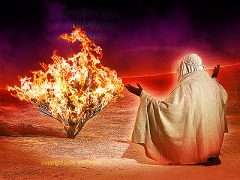 who walked with Adam and Eve in the garden, appeared to Moses in the burning bush, commanded Abraham to sacrifice Isaac, wrestled all night with Jacob, and was found by the Babylonian king Nebuchadnezzar walking around with the 3 Hebrew boys in the fiery furnace.
 who walked with Adam and Eve in the garden, appeared to Moses in the burning bush, commanded Abraham to sacrifice Isaac, wrestled all night with Jacob, and was found by the Babylonian king Nebuchadnezzar walking around with the 3 Hebrew boys in the fiery furnace.
Jesus alluded to this while giving two of His disciples a 7 mile long bible lesson after he was raised from the dead.
.
And beginning at Moses and all the prophets, he expounded unto them in all the scriptures the things concerning himself. Luke 24:27 (KJV)
.
I am a strong advocate for the doctrine of the Trinity, Father, Son, Holy Spirit. God in three persons. Not 3 Gods. Everything that makes God to be God is in each person of the godhead. Each is infinite, all powerful, all knowing, omnipresent. Jesus is not a lesser form of God. He voluntarily humbled Himself and came to earth in order live as a perfect man and become the perfect sacrifice for the dysfunctional human race. He put aside much of His god-ness to operate as a human while still maintaining all of His god-ness simultaneously. He was a helpless baby in his mother Mary’s arms while at the same time keeping every atom in the universe together. Go figure.
.
I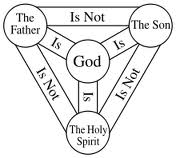 also believe that Jesus is and has always been the primary communicator and the communication from God. We as humans are not equipped to have interaction with the Father.
also believe that Jesus is and has always been the primary communicator and the communication from God. We as humans are not equipped to have interaction with the Father.
As a result of our sinfulness and defective condition and in contrast to the complete and pure holiness of God the Father, Jesus functions as the mediator between God and man.
.
For there is one God, and there is one mediator between God and men, the man Christ Jesus, 1 Tim 2:5 (ESV)
And the Father who sent me has himself borne witness about me. His voice you have never heard, his form you have never seen, John 5:37 (ESV)
.
Everyone who has heard and learned from the Father comes to me—46 not that anyone has seen the Father except he who is from God; he has seen the Father. John 6:45-46 (ESV)
.
The one who has seen Me has seen the Father. John 14:9 (HCSB)
.
Jesus is the only manifestation of the Father that we can understand.
.
5. Jesus the God of the NT is not a sentimental, non judgmental, weak, effeminate, Casper milktoast, slobbering wimp that the liberals want to portray him as. Jesus was a man’s man, who was not afraid to call a spade a spade. He did not come to bring peace but to shake things up.
.

Suppose ye that I am come to give peace on earth? I tell you, Nay; but rather division: 52 For from henceforth there shall be five in one house divided, three against two, and two against three. 53 The father shall be divided against the son, and the son against the father; the mother against the daughter, and the daughter against the mother; the mother in law against her daughter in law, and the daughter in law against her mother in law. Luke 12:51-53 (KJV)
.
Yes he was very forgiving of those who had genuine repentance or called out for help, but he was very judgmental of His brethren willfully involved in sin and those guilty of hypocrisy. His “go and sin no more” was not a platitude, but a command to change, now.
.
You are of your father the devil, and your will is to do your father’s desires. John 8:44 (ESV)
.
You serpents, you brood of vipers, how are you to escape being sentenced to hell? Matt 23:33 (ESV)
.
“Then he will say to those on his left, ‘Depart from me, you cursed, into the eternal fire prepared for the devil and his angels.Matt 25:41 (ESV)
.
Yes we are to take the log out of our own eye before judging another, turn the other cheek and forgive those who hurt us. But once we are sure we are not guilty of what the other guy is doing, we have the responsibility to correct our brother, and to make him stop his evil
 behavior. Jesus personally commission Paul to write the doctrine for these new followers of “The Way”, these new Christians. Paul was led out into the Arabian desert for 3 years and trained supernaturally how this new Christian thing was to work. He was taken into the “third heaven” and shown secrets which there are no human words to convey. We must always remember that Paul, Peter, James, and the gang are writing the exact “God breathed” (θεοπνευστοs, theopneustos) words of Jesus. This whole thing is about and for Him.
.
But the Lord said unto him, Go thy way: for he is a chosen vessel unto me, to bear my name before the Gentiles, and kings, and the children of Israel: 16 For I will shew him how great things he must suffer for my name’s sake. Acts 9:15-16 (KJV)
.
Nor did I go up to Jerusalem to those who were apostles before me; but I went to Arabia, and returned again to Damascus. 18 Then after three years I went up to Jerusalem to see Peter, Gal 1:17-18 (NKJV)
.
I know a man in Christ who fourteen years ago was caught up to the third heaven—whether in the body or out of the body I do not know, God knows. 3 And I know that this  man was caught up into paradise—whether in the body or out of the body I do not know, God knows— 4 and he heard things that cannot be told, which man may not utter. 5 On behalf of this man I will boast, but on my own behalf I will not boast, except of my weaknesses 2 Cor 12:2-5 (ESV)
 man was caught up into paradise—whether in the body or out of the body I do not know, God knows— 4 and he heard things that cannot be told, which man may not utter. 5 On behalf of this man I will boast, but on my own behalf I will not boast, except of my weaknesses 2 Cor 12:2-5 (ESV)
.
For by him were all things created, that are in heaven, and that are in earth, visible and invisible, whether they be thrones, or dominions, or principalities, or powers: all things were created by him, and for him: Col 1:16 (KJV)
.
The above post may contain copyrighted material the use of which has not always been specifically authorized by the copyright owner. It is being made available in an effort to advance the understanding of environmental, political, human rights, economic, democracy, scientific, social justice, for the purpose of historical debate, and to advance the understanding of Christian conservative issues. It is believed that this constitutes a ”fair use” of any such copyrighted material as provided for in section 107 of the Copyright Law. In accordance with the title 17 U.S. C. section 107, the material in this post is shown without profit to those who have expressed an interest in receiving the included information for research and educational purposes.